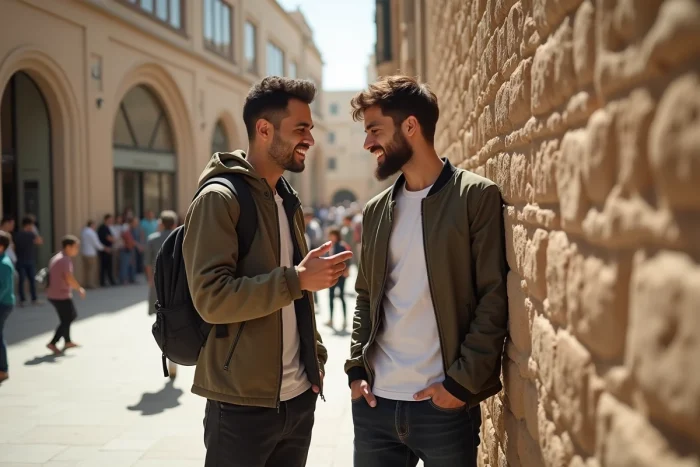
Some words cross borders without ever losing their original nuance, but “wallah lahdim” often escapes literal translation and immediate understanding. The expression circulates in many circles, oscillating between formal promise and marker of authenticity. Its usage varies depending on the context, sometimes accepted orally but rejected in writing, sometimes tolerated in intimacy but prohibited in public. Entire generations use it to seal agreements or reinforce a statement, all while adhering to implicit codes that are rarely articulated.
Wallah lahdim: where does this expression come from and what does it really mean?
To understand the weight of “wallah lahdim,” one must trace back to its Arabic origins. Two words compose this formula: wallah, which means “I swear by Allah,” and lahdim, the oral form of the word “al-‘adheem,” which refers to “the Majestic.” In other words, one who swears this way attaches their word to a sacred value: it is a promise made before God, committing oneself under the aegis of a powerful attribute.
But the significance of this oath does not stop there. In the Muslim tradition, such a commitment has very concrete consequences: it implies that betraying one’s word is not trivial. Religious texts, the Quran and Sunnah, are clear: a vow made in vain, or broken without valid reason, must be repaired through a specific action such as feeding the needy, providing clothing to those in need, freeing a captive, or, if not possible, fasting for several days. In short, every word counts, and every promise binds the one who makes it far beyond a mere stylistic effect.
For several decades, the meaning of wallah lahdim has expanded well beyond the religious sphere. Today, this expression is heard both in the street and at the family table, in school conversations or on urban sports fields. It reinforces the sincerity of a statement, serves as proof in a discussion, or marks a sense of belonging to a shared code. Uses evolve, but one rule endures: this word never quite falls into banality.
Why does “wallah lahdim” provoke so many reactions in daily life?
This oath possesses a particular energy that sometimes shakes up ordinary conversation. In an exchange between siblings, or during a heated debate among friends, using “wallah lahdim” amounts to putting the speaker’s reputation on the line. One does not swear lightly. For many, it is the boundary between mere chatter and a real commitment. Lying after invoking this oath invites lasting distrust, even misunderstanding from the group, as the given word carries significant weight.
In youth circles, the expression has crossed the religious register to invade everyday orality. On social media or in high school courtyards, it is used both as a spontaneous proof and as a knowing wink. This shift is not without creating generational tensions: while some adults worry about trivialization, many young people claim this new usage as a sign of belonging, humor, or loyalty, even if it diverts from its original sacredness.
Here are three typical cases where the formula takes on its full meaning:
- In family, when doubts arise, “wallah lahdim” can calm or resolve a discussion, reinforcing the promise with a word that commits.
- Among friends, it guarantees the truth of an anecdote or a story too incredible to seem true.
- Online, its emotional charge remains vivid, transforming a virtual exchange into a moment of intimacy or confrontation.
Some see it as an excessive use that would drain the word of its initial strength; others argue that its adaptability proves the vitality of language. The multiplicity of meanings, between social pressure and a mark of integration, weaves around this expression a unique place in everyday language.

Current usages and anecdotes around wallah lahdim, between tradition and modernity
Today, the formula has transcended its origins to fully integrate into popular speech. Taken up by teenagers, diverted in rap clips or reality TV, “wallah lahdim” has even found its place in sports jargon or among friend groups in urban neighborhoods. Here, the French language continues to enrich itself through borrowings, exchanges, and cultural hybridizations.
The youth language appropriates the formula, using it both as a rallying cry, proof of sincerity, or simple punctuation of daily life. For sociolinguists like Adéla Šebková, this capacity for hybridization is not a threat to the language, but quite the opposite: she sees it as a renewal, a sign of adaptability, a constant dialogue with diversity.
Some concrete scenes illustrate this phenomenon:
- During a family meal: “Did you finish your homework?, Wallah lahdim, I did everything!”
- After an action on a football field: “Did you score?, Wallah lahdim, really, I’m telling you.”
“Wallah lahdim” thus retains a unique vitality, linking different worlds through the sole power of words. With each turn, the expression regenerates language, building bridges where ordinary discourse stops. In the flowing current of words, some oaths still draw lines of trust and attachment.