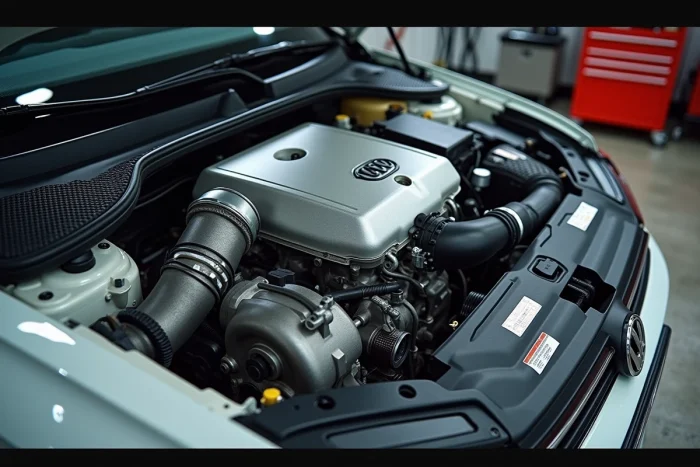
TSI at Volkswagen, TFSI at Audi: two acronyms that are ubiquitous in the used car market and dealerships, often perceived as two distinct technologies. These names refer to turbocharged gasoline engines with direct injection developed within the same industrial group. The choice between a TSI or TFSI branded vehicle does not hinge on a fundamental technological difference, but rather on finer criteria related to the engine generation, intended use, and brand positioning.
What TSI and TFSI Really Hide
TSI stands for Turbocharged Stratified Injection, while TFSI adds an F for Fuel. Both acronyms refer to the same principle: a gasoline engine powered by direct injection and boosted by a turbocharger. The distinction is primarily commercial, with each brand in the Volkswagen group using its own badge to identify its turbo gasoline engines.
Volkswagen, Škoda, and SEAT (now CUPRA) use the TSI badge. Audi employs TFSI. In some generations, the engine block is strictly identical from one brand to another, shared via the group’s modular platform. A 1.4 TSI installed in a Golf can be found, with the same architecture, under the hood of an Audi A3 under the name 1.4 TFSI.
Understanding the difference between TSI and TFSI engines is therefore less about comparing two technologies than about identifying the exact generation of the engine and the specific settings applied by each manufacturer.

Turbo Gasoline Engine Generation: The Real Choice Criterion
A common mistake is to choose between TSI and TFSI as if they were two separate mechanical families. The determining factor is the generation of the block. Recent engines from the Volkswagen group have benefited from significant reliability improvements compared to earlier series, but specialized press continues to report marked differences depending on the model year.
Older Generations and Their Known Weaknesses
The first small-displacement TSI and TFSI engines were associated with several recurring problems:
- Premature wear of the timing chain, particularly on certain 1.2 and 1.4 TSI models from 2008-2013, with a risk of chain failure if maintenance is neglected
- Abnormally high oil consumption on several versions of the 1.8 and 2.0 TSI/TFSI, sometimes from the first tens of thousands of kilometers
- Fragility of the water pump and turbocharger, two components whose replacement represents a significant maintenance cost
The right choice depends more on the exact generation than on the TSI or TFSI badge. A 1.4 TSI from 2016 has little in common, in terms of reliability, with a 1.4 TSI from 2009. Internal developments (engine code EA211 replacing EA111, for example) have corrected some of the structural defects of the earlier series.
How to Identify the Generation of a Block
The engine code, engraved on the block and mentioned on the registration document, remains the most reliable means. Field feedback varies on this point: the same commercial badge (1.5 TSI Evo, for example) can cover variants with different maturity levels. Checking the exact engine code before purchase helps avoid unpleasant surprises.
Audi and Volkswagen Range Positioning: Beyond the Engine
Choosing between a TSI vehicle and a TFSI vehicle also involves a trade-off on trim level, standard equipment, and overall budget. Audi positions its models in a premium segment, which translates into higher prices for comparable engines. The extra cost does not come from the engine itself, but from the trim, soundproofing, interior materials, and onboard technologies.
With identical engine blocks, the price difference between a Volkswagen Golf and an Audi A3 can exceed several thousand euros. In the used car market, this gap narrows, but the cost of specific Audi body and interior parts remains higher.
For daily urban or suburban use, a TSI installed in a Polo or Golf offers a cost/performance ratio that is hard to beat. The TFSI makes sense when the buyer seeks a higher level of comfort and finish, or when they aim for sporty engines absent from the Volkswagen catalog.
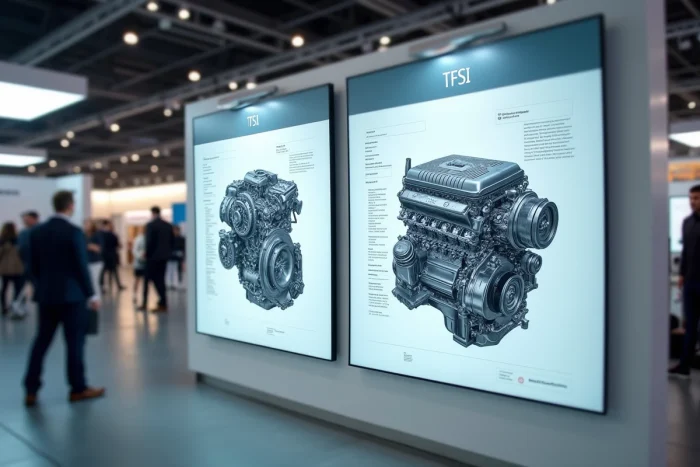
The Case of the 2.5 TFSI: An Engine That Changes the Question
The TSI or TFSI debate loses all relevance as soon as we address the high-end sports segment. The 2.5 TFSI is a 2.5-liter five-cylinder engine reserved for Audi RS models, notably the RS 3. This block has no direct equivalent in the Volkswagen range. It is a performance-oriented engine, with high power and a specific sound character related to the five-cylinder architecture.
This type of engine does not meet the same choice criteria as a TSI from a Polo or Leon. Consumption, maintenance budget, and insurance costs fall into a different category. A buyer who hesitates between TSI and TFSI in this segment is no longer comparing two badges, but two philosophies of use: daily transport on one side, sporting pleasure on the other.
Used TSI or TFSI Engine: Points of Caution
In the used car market, the brand displayed on the hatchback matters less than the maintenance history and the engine generation. A few concrete pointers help guide the search:
- Check the exact engine code and cross-reference this information with reliability feedback published by specialized automotive press
- Request invoices for timing chain replacements on blocks prior to 2013
- Check the oil level and ask about the frequency of top-ups, a revealing sign of excessive consumption
- Prefer vehicles whose maintenance has followed the manufacturer’s plan, with a network follow-up or with a specialist from the Volkswagen group
A well-maintained recent TSI or TFSI engine remains a relevant choice in gasoline engines. Improvements made to the latest generations have reduced historical weaknesses. The final decision hinges on the overall budget (purchase, maintenance, insurance), driving style, and desired trim level, not on the fifth letter of an acronym.