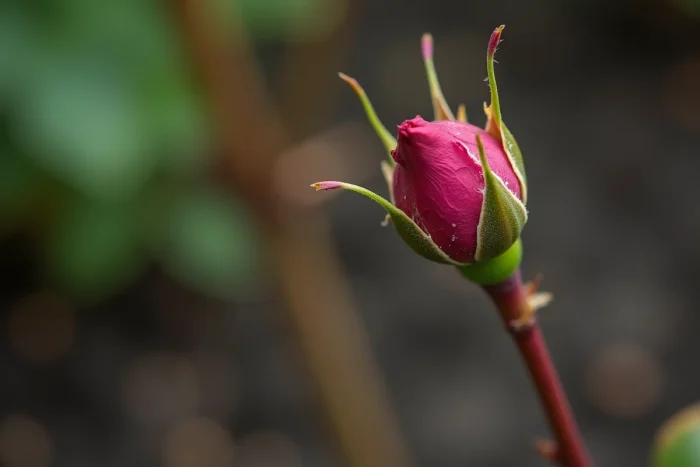
The eye of the rosebush is a small visible swelling on the stem, located at the axil of a leaf or just above a leaf scar. This dormant bud contains in miniature the future shoot, the future leaves, and often, the future flowers. Knowing how to spot and preserve it determines the shape of the rosebush, its vigor, and the quality of its blooming.
Anatomy of the rosebush eye: what a simple bud conceals
A rosebush eye appears as a growth of a few millimeters, sometimes reddish, sometimes green, depending on the variety and the season. It is protected by small scales that open as soon as temperature and light conditions allow.
Not all eyes are equal. The eyes located towards the bottom of the stem, close to the grafting point, are generally more vigorous. They produce strong shoots capable of bearing several floral bouquets. The eyes placed at the top of the stem often yield thinner, less productive shoots.
To understand what a rosebush eye is in detail, one must also distinguish the eye oriented outward from the one turned toward the center of the plant. This orientation determines the direction of the future branch and, consequently, the aeration of the rosebush.

Outer eye or inner eye: the choice that changes the structure of the rosebush
Most pruning guides recommend cutting above an outward-facing eye. The principle is simple: an outward eye produces a branch that moves away from the center, which prevents the entanglement of shoots and limits areas of stagnant moisture conducive to fungal diseases.
On the other hand, on a rosebush with a very sprawling or drooping habit, pruning above an inward-facing eye allows for the re-centering of the vegetation and gives more structure to the whole. This choice therefore depends on the silhouette one seeks and the variety being cultivated.
The case of climbing roses
On a climbing rosebush, the logic changes. The eyes located on the horizontal framework branches are those that yield the most blooms. When a main branch is trained horizontally, the sap is distributed more evenly among the different eyes, instead of rising solely to the top.
This is why a climbing rosebush with vertical branches primarily blooms at the top, while a properly trained rosebush is covered with flowers all the way up. The orientation of the eyes on horizontal frameworks promotes distributed blooming.
Rosebush eye and pruning: where to cut to restart blooming
Pruning is the moment when the knowledge of the eyes becomes concrete. The cut is made at an angle, about one centimeter above the chosen eye, with the slope directed away from the bud. This inclination prevents rainwater from pooling on the eye and causing it to rot.
- For bush roses and hybrid teas, spring pruning (March-April) is done three, four, or five eyes above the ground, retaining the most vigorous eyes oriented outward.
- For shrub roses, a lighter pruning is sufficient: the shoots are shortened by about a third, always above a well-formed eye.
- In summer, the pruning of faded flowers is done above the first or second eye below the flower, which restarts the production of new flowering shoots on remontant varieties.
A clean and well-sharpened pruner is the first condition for a successful cut. A dirty or crushing blade damages the tissues around the eye and opens the door to infections.
Counting the eyes: the rule of three eyes explained
The “three-eye pruning” consists of retaining only three buds on each main branch after cutting. This action, sometimes perceived as radical, forces the rosebush to concentrate its energy on a small number of shoots. The result: thicker stems, larger flowers, and a more compact habit.
On miniature or ground-cover roses, this rule does not apply in the same way. Their pruning often consists of cleaning dead branches and slight shortening, without precisely counting the eyes.
Selection of healthy eyes and disease resistance
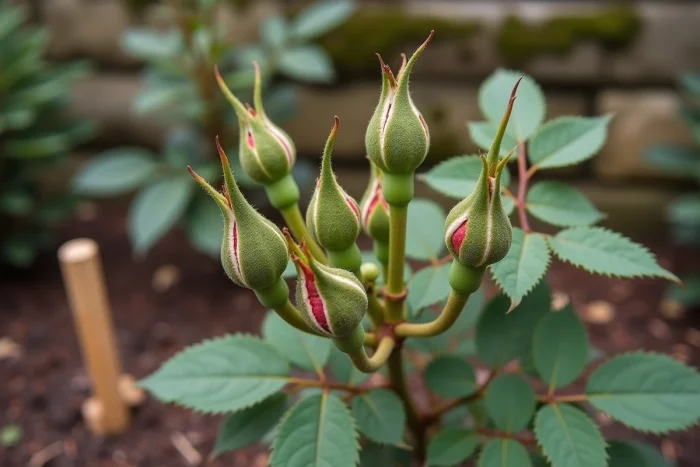
At the time of pruning, not all visible eyes deserve to be kept. A blackened, dried-out eye, or one located on dead wood will yield nothing good. Spotting healthy eyes, that is, those that show a bright color and slight swelling, helps direct regrowth towards vigorous and resistant shoots.
This selection takes on particular significance in the current context. Increasing restrictions on fungicidal treatments in Europe push gardeners to rely more on prevention. Prioritizing healthy and well-aerated eyes reduces the need for chemical treatments by limiting the favorable conditions for the development of marsonia (black spots) and powdery mildew.
A rosebush with a cleared center, thanks to pruning focused on the outer eyes, dries more quickly after rain. Air circulates between the branches. Fungal spores find fewer moist surfaces to germinate.
Rosebush eye and flower quality: beyond the number of flowers
The eye of the rosebush not only determines the number of flowers. It also influences the size of the buds, the length of the stems, and, on certain old varieties, the intensity of the fragrance. A shoot from a vigorous eye, well nourished by the sap, produces more developed flowers than a shoot from a weakened eye.
Removing the first buds in spring forces the rosebush to redirect its sap to the remaining eyes. This action, passed down by experienced gardeners, delays the first bloom by a few weeks but increases its density for the rest of the season.
Field reports vary on this point depending on the varieties: some very remontant modern roses do not benefit from it in the same way as old varieties with single blooms. Observation over several years remains the best guide to adapt this practice to each plant.
Each rosebush eye is a decision waiting to be made. Knowing which one to keep and which to remove transforms mechanical pruning into a precise action, tailored to the variety, the desired habit, and the garden conditions. It is this small swelling of a few millimeters that ultimately decides the appearance of the rosebush throughout the year.