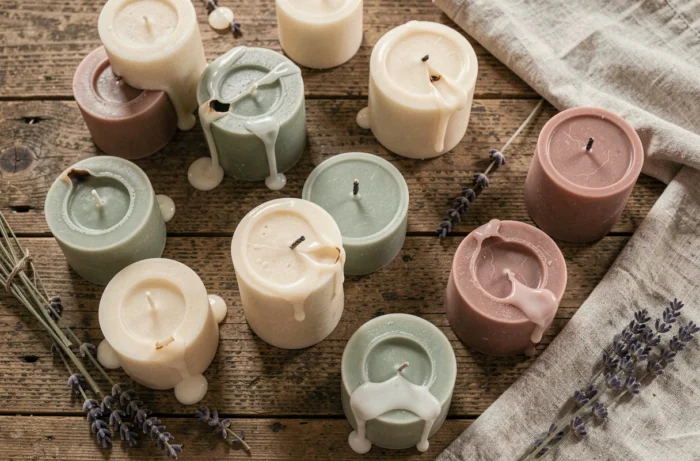
Between soy wax, rapeseed wax, and plant blends, French artisanal candles are not just about a pleasant scent. Choosing a candle for your home raises questions about composition, regulation, and sustainability that most product sheets do not address. What criteria truly distinguish an artisanal candle from a scented industrial candle, beyond marketing?
Plant Wax or Paraffin: What Composition Changes Concretely
The type of wax determines the combustion, scent diffusion, and environmental footprint of a candle. Today, French artisans favor plant waxes, while the majority of global industrial production still relies on paraffin, a petroleum derivative.
| Criterion | Plant Wax (soy, rapeseed, coconut) | Paraffin |
|---|---|---|
| Origin | Renewable resources | Petroleum derivative |
| Combustion | Slower, lower temperature | Faster, higher temperature |
| Scent Diffusion | Progressive and steady | Intense at first, decreasing |
| Soot | Very low | More pronounced |
| Biodegradability | Yes | No |
Non-GMO and pesticide-free soy wax, combined with a pure cotton wick, produces a gentle and even burn. Soy-coconut blends enhance scent retention in larger containers.
The French artisanal candles offered on https://www.maisonfloran.fr/ illustrate this trend towards plant-based compositions crafted with local perfumers.

Allergen Labeling: The European Regulation Buyers Overlook
Since recent updates to the EU CLP (Classification, Labelling and Packaging) framework, the list of fragrance allergens that must appear on the label of a scented candle has expanded. This tightening directly affects French artisans, even the smallest workshops.
In practice, each artisan must verify the classification of their scented blend based on safety data sheets and IFRA declarations provided by their suppliers. When certain thresholds are exceeded, the label must include hazard statements, precautionary advice, pictograms, and specific mentions like EUH208 for sensitizers.
This regulatory framework serves as a quality filter that is often underestimated. A compliant artisanal candle displays its allergens, pictograms, and precautionary advice. An imported candle without complete labeling poses a traceability issue.
What the Label of an Artisanal Candle Must Mention
- The classification of the scented blend according to the CLP regulation, with corresponding pictograms if necessary
- Fragrance allergens present above regulatory thresholds, named individually
- Appropriate hazard statements and precautionary advice (for example, the EUH208 mention for sensitizing substances)
- The name and contact details of the market responsible party
An artisan who details their composition on the label stands out clearly from generic production.
French Artisanal Candles and “Clean Label” Formulations: A Measurable Trend
Recent market analyses confirm that the growth of the candle and ambient fragrance segment in France is now driven by natural formulations and ingredients perceived as clean. Without paraffin, without phthalates, with increased transparency on allergens: the specifications have tightened on the consumer side.
This demand is not limited to wax. Pure cotton wicks replace metal-core wicks. Recyclable glass containers extend the lifespan of materials. And the fragrances themselves are reformulated to reduce the presence of controversial volatile compounds.
Three Criteria to Identify a Truly Artisanal Candle
The word “artisanal” is not protected. Any reseller can use it. However, a few concrete indicators allow for sorting:
- The place of manufacture is identifiable (named workshop, specific city, not just “made in France” without an address)
- The product sheet details the type of wax, the origin of the wick, and CLP regulatory compliance
- The fragrance is developed by an identified perfumer, often based in Grasse, with an accessible IFRA declaration
An artisanal candle that meets these three criteria is positioned in a verifiable quality segment, not just declarative.
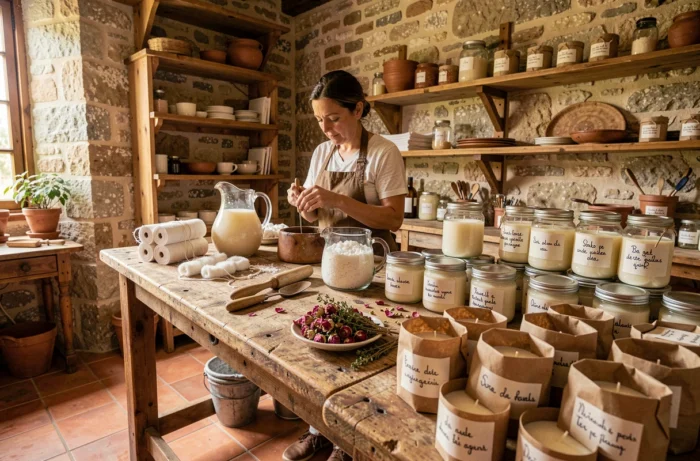
Diffusers, Melts, and Sprays: What Alternatives to Candles for Scenting a Home
The candle is not the only vehicle for artisanal ambient fragrance. Scented melts, mikados (reed diffusers), and room sprays complement the offerings of French workshops, each with a distinct diffusion method.
Melts are warmed on a flame-free burner and release their fragrance more intensely over a short duration. The mikado, on the other hand, diffuses continuously for several weeks without intervention. The spray offers immediate but fleeting scent, useful before guests arrive or to refresh a room temporarily.
The choice depends on the size of the room and the desired use. For an open living room, a mikado paired with a lit candle in the evening creates a richer olfactory layering than a single product. For a bedroom, a melt or spray is sufficient to set an ambiance without prolonged combustion.
Containers and Recyclability: An Underestimated Choice Criterion
The container represents a significant portion of the cost of an artisanal candle. French workshops primarily use recyclable glass, sometimes ceramic or polished concrete. A reusable container transforms the candle into a lasting decorative object once the wax is consumed.
Some artisans offer a refill service: the customer returns or brings back the empty container, which is cleaned and refilled. This model reduces final waste and builds customer loyalty, but it remains a minority due to the lack of suitable logistics among small producers.
Choosing a French artisanal candle goes beyond just the scent. Wax composition, CLP regulatory compliance, transparency on allergens, and recyclability of the container form a set of verifiable criteria. It is these technical elements, more than packaging or storytelling, that distinguish an artisanal product from a repositioned industrial product.