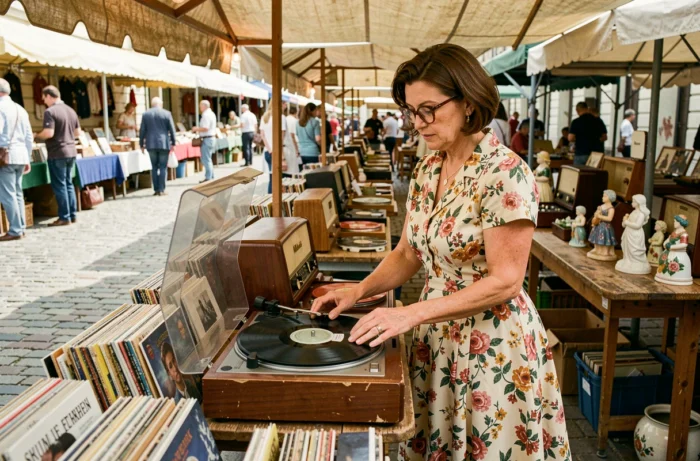
At a flea market, you come across a Bialetti Italian coffee maker from the 1970s, still functional, sold for three euros. In a recycling center, a rattan chair awaits a second life. These items are not curiosities: they feed into a second-hand market that far exceeds the phenomenon of thrift stores and now encompasses furniture, decoration, games, and everyday equipment.
Second-hand furniture and decoration: the segment overshadowed by vintage fashion
When we talk about retro culture, fashion grabs the attention. Parisian thrift stores, faded denim jackets, and collector sneakers monopolize social media. However, second-hand furniture and decoration remain a massive segment of the market.
According to an analysis published in September 2026 by Speeral (citing Fevad data from 2025), about one in four pieces of furniture sold in France is second-hand. This includes dressers, lighting fixtures, tableware, and frames, not just high-end designer pieces sold at auction.
What makes this market interesting on the ground is its diversity of channels. Between online auctions, specialized consignment shops, itinerant antique dealers, and dedicated platforms, entry points have multiplied. To keep up with the news in this universe and spot remarkable pieces, Retro’ Revue regularly covers trends in the retro and vintage market, from furniture to collectibles.
The direct consequence: prices vary greatly depending on the channel. A lot of Mullca chairs found in a clearance warehouse will not cost the same as the same lot offered by an antique dealer in the Marais. The purchasing channel influences the price as much as the item itself.
Textile regulation and vintage items: what is changing concretely
You might not think about it while hunting for a military jacket or a tea set, but recent European regulations are changing the rules of the game for the entire second-hand sector.
Extended producer responsibility for textiles
The European framework for extended producer responsibility (EPR) for textiles has been strengthened. Manufacturers’ contributions must now be adjusted according to the sustainability and recyclability of their products. National systems must be gradually implemented by 2028.
In practice, this means that brands producing low-durability clothing will pay more. This financial pressure indirectly promotes repair and reuse, and thus the appreciation of vintage pieces already in circulation.
Gradual ban on destroying unsold items
Large European companies can no longer destroy their unsold textile items without constraints. They must also publish information on the volumes involved. On the ground, this pushes some of these stocks towards donation, repair, or resale in the second-hand market.
For hunters, the returns vary on this point: some see better quality lots appearing in clearance channels, while others mainly notice an influx of reconditioned fast fashion that lowers standards.
Identifying a vintage item worth the detour: operational criteria
This is not about becoming an expert in valuation, but about quickly spotting pieces that deserve attention, whether for decoration, collection, or resale.
- The structural condition takes precedence over aesthetics. A patina on a solid wood piece adds character. A crack in the structure does not. Check the joints, hinges, and welds before looking at the style.
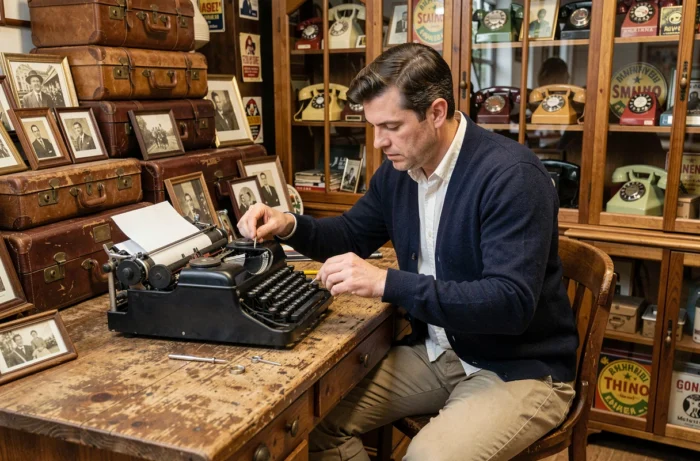
- Markings and stamps. On ceramics, furniture, or glassware, a hallmark, serial number, or manufacturer’s signature helps identify the origin and period. Without marking, attribution remains speculative.
- The consistency of materials. An item presented as “1950s” but made of MDF or ABS plastic raises questions. The materials used (solid wood, bakelite, cast iron, blown glass) are often the best indicator of the era.
- The potential of the lot. In flea markets or auctions, buying a complete lot (table service, vinyl collection, set of chairs) costs proportionally less than purchasing piece by piece. It’s also a lever for resale.
Solidarity shops vs. online platforms: the real environmental impact
The ecological argument is systematically part of the discourse on second-hand. Buying vintage means consuming responsibly. The reality is more nuanced.
Logistics is the main differentiating factor between channels. Individual parcel shipments generate a carbon cost per item that is much higher than that of a purchase in a physical store, where several items are grouped under one roof without additional transport.
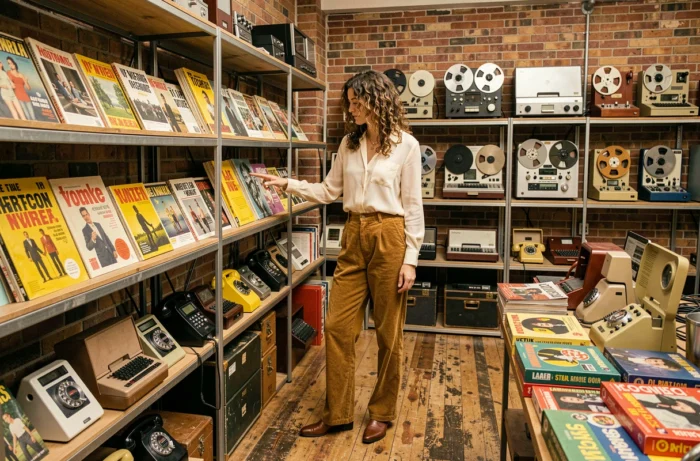
For retro culture enthusiasts, the choice of channel is therefore not neutral. Hunting in person at a recycling center, a flea market, or with a local antique dealer remains the least transport-intensive option. Online platforms offer a wider catalog, but each delivery has an environmental cost that the label “second-hand” does not erase.
Balancing the joy of hunting with coherence
Consolidating online purchases, prioritizing local sellers when the platform allows it, or combining a visit to a vintage fair with several acquisitions: these adjustments reduce the footprint without sacrificing the diversity of the offer.
The market for vintage items and retro decoration is not just a decorative trend. It is a structured economic circuit, governed by rapidly evolving regulations, and its environmental impact depends as much on the distribution channel as on the nature of the items. Knowing where to look, what to check, and how to buy makes all the difference between a good find and an impulsive purchase that ends up at the back of a closet.