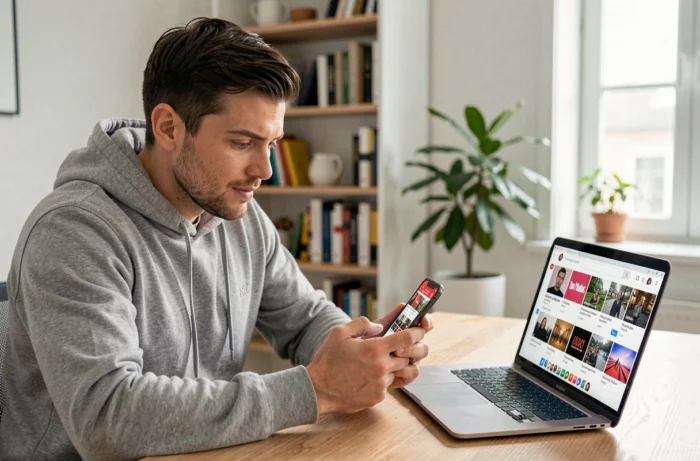
DNews is a news application available on both the Google Play Store and YouTube. These two environments do not handle information in the same way, do not recommend content based on the same criteria, and do not target the same times of day for a user. Understanding these differences helps to better grasp what each platform offers and what it overlooks.
Recommendation Algorithm: Two Distinct Logics for DNews
On Google Play, DNews operates as an aggregation app. The user downloads it, opens it, and accesses a stream of articles and briefs structured around their declared or detected interests. The system is similar to that of Google News, with a full coverage function that groups multiple media treatments of the same event.
On YouTube, the logic changes. The platform now separates its recommendation systems between Shorts and long videos. Shorts prioritize quick discovery and place particular weight on the recency of content. Long videos, on the other hand, favor watch time and in-depth engagement. DNews, when it publishes on YouTube, is subject to this segmentation without the ability to bypass it.
An article detailing the functioning of DNews according to the platform allows for measuring the concrete gap between these two ecosystems. What appears at the top of the Google Play feed is not what will be pushed in the YouTube feed of the same user, even if the topic covered is identical.

Editorial Format on Google Play versus YouTube: What the Platform Imposes
The Android store structures the experience around the app listing. Description, screenshots, user reviews, ratings: ASO (App Store Optimization) determines the visibility of DNews against other news applications. The editorial content itself remains within the app, inaccessible to the Play Store’s search engine.
YouTube imposes a completely different framework. Each publication becomes an indexable, commentable, shareable video. The title, thumbnail, and the first few seconds determine the click-through rate. YouTube has also strengthened its tools for newsrooms in 2026, with editorial analysis functions focusing on narrative structure, pacing, and dynamic thumbnails tailored to each viewer’s profile.
This difference is not trivial. On the Play Store, DNews controls its interface. On YouTube, it is one channel among millions, subject to the same algorithmic rules as an independent creator or an entertainment channel.
Consequences for Content Production
Producing for Google Play means maintaining a reliable app, updating regularly, managing subscriptions, and push notifications. Producing for YouTube means creating videos with appropriate editing, a calibrated hook, and a duration that meets format expectations (short for Shorts, more developed for classic content).
DNews editorial teams must therefore adapt their production to each ecosystem, which requires distinct skills and resources. A text article optimized for the app does not simply translate into a high-performing video on YouTube.
Discover, Google News, and YouTube: Three Streams That Do Not Overlap
A common point of confusion concerns the relationship between Google News, Google Discover, and YouTube. These three services are not interchangeable:
- Google News is a dedicated application for aggregating news articles, with multi-source coverage per event. DNews appears there as a source if it meets Google’s editorial criteria.
- Google Discover is a feed integrated into the Google app, Chrome, and the search engine’s homepage. It mixes articles, videos, and posts by anticipating interests, without the user having formulated a query.
- YouTube recommends video content based on its own signals (viewing history, retention rate, interactions). A DNews content visible on Discover may be absent from YouTube, and vice versa.
For the user who consults DNews on the Play Store, the feed remains controlled by the app. On YouTube, this same user depends on an algorithm that does not treat news as a priority category, unless they explicitly configure their subscriptions.

Monetization and Business Model According to the Platform
The Play Store offers several levers: paid downloads, in-app purchases, subscriptions. DNews can build a direct model with its users there, for example by offering a premium ad-free access or extended features.
YouTube relies on a shared advertising model. Revenues depend on the number of views, watch time, and the demographic profile of the audience. YouTube has also expanded its monetization options for news channels, with channel memberships and revenue tools dedicated to newsrooms.
The two models are not incompatible, but they require trade-offs. On the Play Store, the user pays directly for the service. On YouTube, it is attention that is monetized. The nature of the relationship between DNews and its audience differs depending on the chosen channel.
Impact on Editorial Independence
A subscription model on the Android store gives DNews more latitude to choose its topics without depending on click volume. On YouTube, algorithmic pressure pushes towards formats that maximize retention, which can conflict with a sober and factual news treatment.
The available data do not allow us to conclude that either model guarantees better editorial quality. Field feedback varies on this point, and the answer largely depends on the strategy adopted by each newsroom.
DNews illustrates a tension shared by most digital media: being present where the audience is without losing control of its editorial product. The Play Store offers a controlled framework, with a direct relationship to the user. YouTube offers considerable reach, at the cost of dependence on the rules of an ecosystem designed for video, not for news. Choosing between the two, or combining both, remains a decision that engages the very nature of the media.