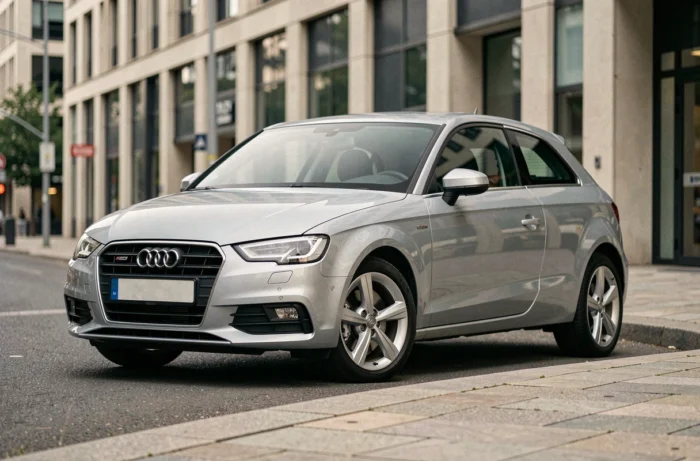
The Audi A3 Sportback is based on the MQB evo platform, which directly influences the distribution of interior volumes. Understanding how space is allocated between passengers, trunk, and mechanics allows one to choose the right engine for their actual use, as not all versions offer the same compromise between habitability and storage.
Impact of the plug-in hybrid engine on the usable volume of the Audi A3 Sportback
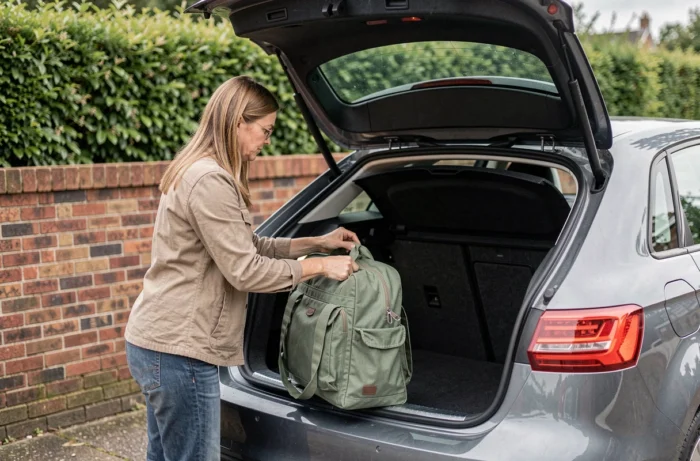
The 40 TFSI e version reduces the trunk to 280 liters, compared to 380 liters for the thermal and micro-hybrid variants. This is not a detail: we are talking about a loss of 100 liters, equivalent to one less hard-shell cabin suitcase.
This reduction is explained by the placement of the traction battery under the rear bench and floor. The electrical components occupy space that, in the classic TFSI or TDI versions, remains available for loading.
With the rear seats folded down, the 40 TFSI e reaches 1,100 liters. The ratio remains acceptable for a one-time move or a vacation trip for two, but the loading threshold is slightly higher than on a thermal A3 Sportback. We recommend physically checking the height of the trunk floor before purchase if you regularly transport heavy or bulky items.
For those who want to discover the dimensions of the Audi A3 Sportback in detail, the comparison between thermal and plug-in hybrid versions is the first sorting criterion.
Real rear habitability: what the measurements don’t tell
The technical sheets display a generous wheelbase for the premium compact segment. On paper, the fourth generation gains a few centimeters in length and width compared to its predecessor. In practice, the rear knee space is still conditioned by the driver’s seat adjustment.
A tall driver (over 1.85 m) who moves their seat back into a comfortable position leaves sufficient knee clearance for an average adult, but not for a passenger of the same size. The A3 Sportback remains a compact, not a D-segment sedan.
The rear headroom also deserves attention. The sportback design, with its sloping roofline, reduces the available space at head level for passengers over 1.80 m. This is a stylistic compromise accepted by Audi, which prioritizes a dynamic silhouette.
Elbow width and middle seat
Three adults side by side in the back remain an occasional configuration. The central tunnel, inherited from the MQB architecture, encroaches on the floor space of the middle passenger. The elbow width is suitable for two adults and a child, a realistic configuration for everyday use.
Trunk and modularity: compromises depending on TFSI, TDI, and TFSI e versions
The trunk volume of 380 liters in the thermal versions places the A3 Sportback in the higher average of the segment. To put this figure in perspective, it is comparable to what its direct rivals offer in premium compacts.
- 30 TFSI and 35 TFSI versions (gasoline, micro-hybrid): flat trunk floor, low loading threshold, 380 liters usable without layout constraints
- TDI versions (diesel): same volume, slightly higher weight on the rear axle which stabilizes behavior under full load
- 40 TFSI e version (plug-in hybrid): 280 liters, raised floor, partially occupied subfloor by the battery, cable storage for charging to be considered in the remaining volume
The rear bench folds down in a 60/40 configuration across all versions. The mechanism is the same, but the floor does not end up perfectly flat on the 40 TFSI e due to the height offset imposed by the battery.

Exterior dimensions and maneuverability in urban environments
With its fourth generation, the A3 Sportback has gained an additional three centimeters in length and width compared to the previous model. This growth remains contained, but it has concrete consequences in the city.
The turning radius has not evolved proportionally to the increase in wheelbase. In tight parking or in Parisian underground parking, the A3 Sportback requires a bit more anticipation than a city car, without posing major difficulties. The 17 or 18-inch wheels, common on S line trims, increase the risk of hitting a curb during maneuvers.
Width without mirrors and covered parking
The overall width with mirrors deployed significantly exceeds the body width displayed in the specifications. We note that this point is rarely mentioned, yet it conditions passage through certain narrow parking spaces in older residential parking lots. Folding the mirrors electrically (available depending on the trim) becomes almost standard in these situations.
- Check the width without mirrors, not just the body measurement, before signing a purchase if your parking space is constrained
- Versions equipped with 18-inch wheels offer a premium look but reduce the height of the tire sidewall, thus lowering tolerance to curb impacts
- Park assist, offered on the new generation, partially compensates for the size increase
The weight varies significantly depending on the engine. The plug-in hybrid versions carry a notable additional mass related to the battery, which is felt in low-speed dynamics and during parking maneuvers on slopes.
The Audi A3 Sportback remains a premium compact whose interior space depends as much on the chosen version as on the raw dimensions. Choosing between TFSI, TDI, and 40 TFSI e comes down to balancing trunk volume and electric range. This compromise, more than the displayed centimeters, determines daily satisfaction.