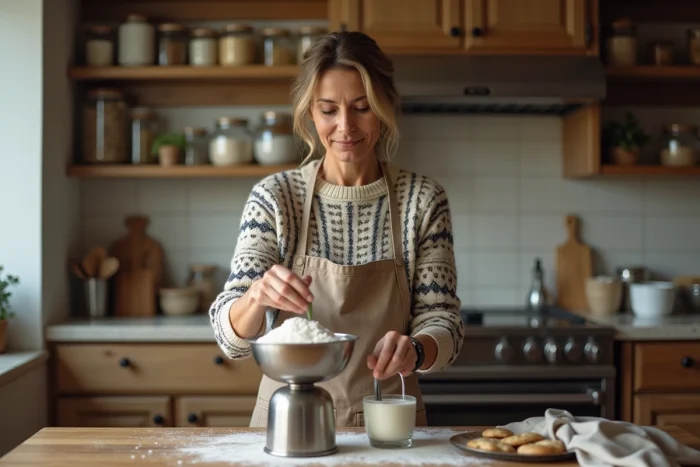
300 g and 300 ml: the confusion does not come from chance, but from a very real playground where each ingredient imposes its own rules. Conversion is not an automatic operation. Flour, sugar, butter… each stands firm in its position, occupying a volume that is unique for the same quantity. The result: one must navigate this diversity, even if it means shaking up habits and banning shortcuts.
In many recipes, grams and milliliters exchange roles, sowing doubt in the cook’s mind. But switching from one to the other requires more than just a simple calculation. The ingredient matters, and precision makes the difference between a failed dough and a successful preparation.
Grams and milliliters in cooking: understanding the difference to better succeed in your recipes
Reading a recipe sometimes means confronting two worlds: grams, which measure mass, and milliliters, which evaluate volume. It is impossible to mix them indiscriminately. Take flour: its density differs radically from that of water. Sugar, depending on its fineness, also takes liberties with the scale. It’s all a matter of density and specific mass, this invisible filter that separates the ingredients.
A volume is the space occupied in a container; a mass, on the other hand, never changes, regardless of the container. That’s why conversion must remain attentive to density. Water, however, is an exception: 1,000 grams for 1 liter, the equation is clear. But if we switch to oil, honey, or flour, this ratio collapses. Understanding specific mass ensures that the recipe does not derail.
Want to know how to convert 300g to ml? It’s not just about solving a simple equation. You need to observe, adapt, take into account the density and texture of each product. This approach sharpens the technique, banishes approximation, and gives each recipe its chance to succeed. Before converting, look at the density, state, granularity, or even the moisture of the ingredient.
Here are some guidelines to help you with your conversions:
- Water: 300 g = 300 ml (density 1)
- Milk: 300 g ≈ 291 ml (density 1.03)
- Flour: 300 g ≈ 570 ml (density 0.53)
- Granulated sugar: 300 g ≈ 375 ml (density 0.8)
What reflexes to adopt to convert 300 g to ml according to each ingredient?
To switch from grams to milliliters without making mistakes, there is only one rule: adapt your method to the ingredient. Density guides each conversion. Water simplifies everything: 300 g transforms into 300 ml, without calculation. But for milk, the slightly higher density reduces the volume to about 291 ml. Olive oil, being lighter, reverses the trend: 300 g approaches 333 ml.
With flour, the difference is striking: 300 g occupies nearly 570 ml, a direct consequence of its low density. The formula to keep in mind: volume (ml) = mass (g) / density. This reflex protects against discrepancies and provides a solid foundation for successfully preparing your dishes.
Some benchmarks for the most common ingredients:
- Water: 1 g = 1 ml
- Milk: 1 g ≈ 0.97 ml
- Olive oil: 1 g ≈ 1.11 ml
- Flour: 1 g ≈ 1.9 ml
Get ready: keep your measuring cup or kitchen scale handy for each transition from milliliters to grams. The mass-volume formula is a faithful ally, capable of adapting to any ingredient. Compare, adjust, and measure carefully to ensure the consistency of your recipes.

Conversion table and practical tips for gaining precision in everyday cooking
The conversion between grams and milliliters requires constant vigilance regarding density. Those who venture into the kitchen have already experienced it: an error in mass or volume can throw a dish off balance. To speed things up and limit risks, it is wise to always have a clear conversion table at hand, placed on the countertop.
| Ingredient | 300 g in ml | Density |
|---|---|---|
| Water | 300 | 1.0 |
| Milk | 291 | 1.03 |
| Olive oil | 333 | 0.9 |
| Flour | 570 | 0.53 |
To measure accurately, an electronic kitchen scale remains essential, while the measuring cup translates the desired volume at a glance. Use the universal formula, volume = mass / density, to find the exact correspondence between 300 g and the necessary milliliters. This simple reflex protects your recipes from unfortunate discrepancies.
And if technology simplifies your life: choose a reliable app or an online converter. Speed, accuracy, and peace of mind are then guaranteed. Ultimately, it is precision that makes the difference at the table, and each successful conversion becomes the promise of a dish that meets expectations.